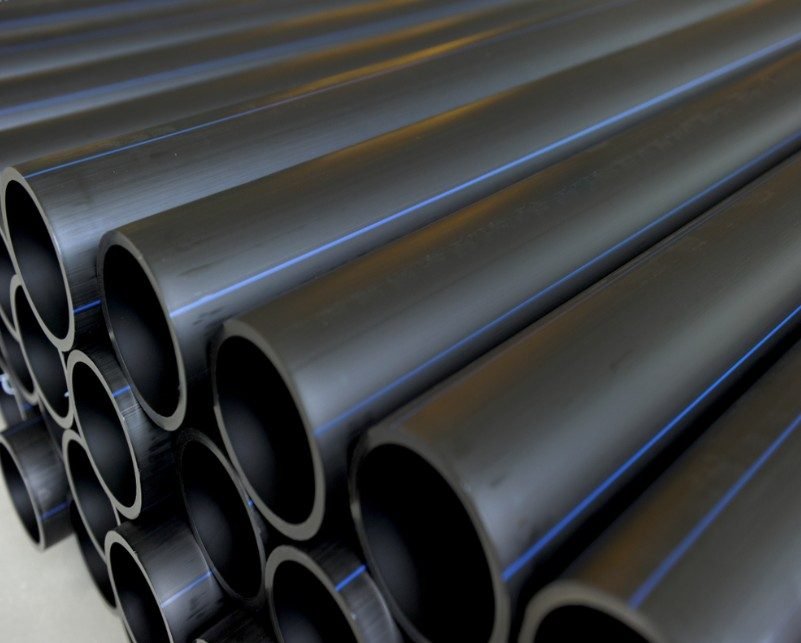
Corrosion resistance, flexibility and strong joints: why HDPE has changed the conversation around modern piping.
Sounds almost too good to be a pipe, doesn't it? But that's exactly what makes HDPE pipes interesting.
We usually don't think twice about the pipes carrying water to our homes, farms, factories, or construction sites. Most of them spend their entire lives underground, behind walls, or hidden inside infrastructure. Yet they are expected to deal with pressure, moisture, chemicals, changing temperatures, rough surroundings, and years of continuous use.
That is where HDPE—High-Density Polyethylene—has changed the conversation around modern piping.
HDPE doesn't rust
One of its biggest advantages is something very simple: HDPE doesn't rust. Unlike traditional metal pipes, HDPE is naturally resistant to corrosion. This becomes particularly important in water infrastructure, agricultural systems, and industrial applications where pipes can remain exposed to moisture or come into contact with different chemicals over long periods.
But corrosion resistance is only part of the story.
The real strength of HDPE lies in its flexibility
Think about installing a rigid pipe through uneven terrain. Every bend, change in direction, or movement in the ground can create additional stress. A rigid system may require more joints and fittings to accommodate those changes.
HDPE behaves differently. Its flexibility allows it to accommodate bends and ground movement more effectively, making it suitable for applications where the surrounding conditions aren't always perfectly predictable.
And then there's durability
A pipe installed underground isn't living an easy life. It may face soil pressure, temperature changes, impact during handling, and continuous internal water pressure. The material needs to withstand these conditions without becoming a maintenance headache.
That's why the material selection matters so much. HDPE pipes are known for their combination of strength, flexibility, corrosion resistance, and long-term performance, making them useful across a wide range of applications—from water supply and agriculture to industrial and infrastructure projects.
Fewer joints, fewer leaks
Another important advantage is the way HDPE pipe systems can be joined. Depending on the application, techniques such as butt fusion and electrofusion can create strong, reliable joints. Fewer mechanical joints can also mean fewer potential points of leakage in the system. And when you're dealing with water infrastructure, that matters.
Because a piping system isn't only about moving water from one place to another. It's about doing it efficiently, reliably, and with as little interruption as possible.
- For agriculture, this can mean dependable water delivery across irrigation networks.
- For industries, it can mean transporting fluids through demanding environments.
- For water supply systems, it can mean building infrastructure designed for long-term service.
Of course, no pipe is a magic solution for every application. The right product still depends on factors such as pressure requirements, diameter, installation conditions, temperature, application, and relevant standards.
That's an important part of choosing any infrastructure product: don't just ask what the material can do. Ask whether it's the right material for the job.
At SBM Gold, we see HDPE as more than another product in a catalogue. It represents what modern infrastructure increasingly demands—materials that are durable, adaptable, efficient, and designed with long-term performance in mind.
Because sometimes, innovation isn't about making something complicated. Sometimes, it's about creating a material that can take on the challenges around it without giving up.
- It doesn't rust.
- It can handle movement.
- It can take on demanding conditions.
And when it's designed, manufactured, and installed correctly, it can quietly keep doing what it was made to do—year after year.
That's the kind of strength you don't always see. But infrastructure definitely feels the difference.
Have a question about your project? Call us toll free on 1800-8893-850.